
Walk into a yoga studio, retreat center, or living room gathering today and you’re likely to encounter something ancient. A singing bowl hums. A chant ripples through the room. A drum begins a steady heartbeat. Someone calls it a sound bath. Someone else calls it sacred music. Or New Age. Someone else just closes their eyes and thinks, “Ahhh… yes.”
This isn’t a trend that came out of nowhere. It’s a remembering. And it’s innovative. One of the more creative energies in this space we’re calling Enlightenment.
Across cultures and millennia, humans have used sound and music to alter consciousness. If you’re as old as me, you recall the consciousness-raising mission of music in the 60s and 70s. What’s happening now in this yoga-connected domain of music is another consciousness-raising mission. In a world that feels crowded, loud, and dissonant we are rediscovering and adapting ancient sounds to change the vibe. And they work because we directly feel rhythm, resonance, and harmony. The right music can lead us into meditation and sustains the feeling of vibrant peace after it.
Disclosure
I would like to add a brief note before continuing: I am of Anglo-European ancestry, born and raised in the US. If any of the following is overly generalized, simplistic, or completely misinformed please leave comments. Everything on this website is open for discussion and input. Your points will help me and others enlarge our perspective.
Sound bypasses thinking
We don’t need to analyze a drumbeat to feel it. We don’t need to understand a chant to sense something sacred. Music slips past the part of the mind that argues, doubts, narrates, and worries. It goes straight to the nervous system where its impact can be felt and measured.
Modern neuroscience now confirms what ancient practitioners intuited: rhythm and repetition can calm the stress response, regulate emotion, synchronize brain activity, and reduce the mental chatter that disrupts our peace of mind. In contemplative language, sound helps quiet the ego long enough for awareness to notice itself.
Where science meets practice, Paramahansa Yogananda put it with characteristic simplicity: “Chanting is half the battle.”
He was referring to the battle most of us have with our monkey mind — that chatter box within that just won’t shut up, particularly when we want to meditate. Yogananda highly recommended chanting before meditating to calm the monkey mind and open the heart so that meditation can happen more effortlessly.
Music is more than entertainment
Chanting is an ancient practice that is rooted deeply in indigenous cultures as well as world religions. With both sacred and secular applications, it’s worship, prayer, meditation, healing, community building, communing with ancestors, and with the living. It’s been with us for as long as we know and shows no sign of disappearing. It’s also now the subject of scientific research, with physiological and psychological benefits that echo those of meditation.
Long before spiritual practices became a self-help category, the Upanishads made the claim that reality is vibrational.
The Mandukya Upanishad described Om (AUM) not as a symbol but as a sonic map of consciousness. The sound corresponds to waking awareness, dreaming, deep sleep, and the “fourth” state, turiya, which lies beyond all of them. Chanting Om was and still is a way to tune into a unified field of consciousness.
From this view, chanting works because consciousness responds to resonance. When breath, sound, and attention align—awareness naturally settles into deeper, subtler states. At that level, silence emerges, and sound can take us there.
Buddhism: Same Practical Wisdom
Buddhism is also clear about monkey mind. A primary obstacle to awakening is the restless, discursive mind. Chanting is not just an aid to meditation. It can be the whole meditation.
From early Pali chants to Zen sutra recitation to Tibetan mantra practice, sound is used to gather attention, regulate emotion, and stabilize awareness. The meaning of the words matters far less than their rhythm, repetition, and embodiment.
Zen monks chant for hours to keep the mind from wandering while dissolving the sense of a separate “doer.” Tibetan Buddhists use mantra as a precision tool, synchronizing sound, breath, and visualization to reshape habitual mental patterns.
Sound bypasses thinking and belief, taking one directly to quieter awareness where silence abides.
Bhakti: Divine Love Songs
Bhakti yoga traditions emphasize the heart, and chanting is the main devotional practice. Singing the name of the divine purifies the mind, softens the ego, and redirects desire inward. Sound transforms as a divine exchange of love. Singing and emotion work together. Joy becomes a vehicle for transcendence.
Ramakrishna famously taught that in the age of distraction, devotional chanting is the safest and most accessible path.
Indigenous Traditions: Music as Relationship
For many Indigenous cultures, music is relationship. Songs are received from ancestors, spirits, plants, animals, or the land itself. They are activated in specific contexts for healing, initiation, mourning, celebration, or guidance.
In North American Indigenous traditions, drumming is often called the heartbeat of Mother Earth. Repetitive rhythm induces trance, emotional release, and a sense of belonging larger than the individual. In Amazonian cultures, sacred songs guide visions, regulate altered states, and transmit knowledge directly through melody and tone. Australian Aboriginal chant to communicate with ancestors and spiritual beings. Some songlines encode geography, law, and cosmology, keeping both land and consciousness aligned through singing.
Group rhythm synchronizes bodies and minds. Repetition stabilizes attention. Shared sound dissolves isolation and makes deep connections to a broader whole.
Singing Bowls and Sound Baths: Ancient Inspiration, Modern Innovation
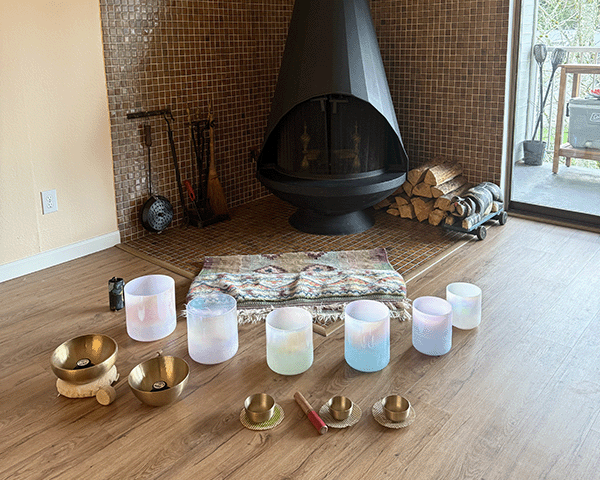
Sound baths can be healing, meditative, and profoundly relaxing. Today’s singing bowls are taking new shapes and forms, making their way into yoga classes, churches, and living rooms where people gather to deepen meditation experiences.
Metal bowls have existed for centuries across the Himalayan region, but there’s little evidence they were used in the immersive, therapeutic ways we see today. What is ancient is the understanding that sustained sound can settle the mind and open awareness.
Modern sound baths are contemporary practices inspired by ancient sound wisdom. They combine bowls, gongs, chimes, and sometimes voice to create an immersive sonic fields. Research suggests these experiences can reduce stress, improve mood, and promote relaxation by activating the parasympathetic nervous system and quieting mental chatter.
Why so repetitive?
Across all these traditions, one pattern repeats as reliably as a drumbeat: meditative sound is repetitive.
Repetition does something thinking cannot. It gently calms the monkey mind and stops its chatter. It draws awareness into the very appealing sensations of sound where it settles into spaciousness and silence.
This is why mantras repeat. Why chants loop. Why drums pulse. Why songs circle back to where they began.
Perhaps it started in the womb where we were soothed by the steady repetition of our mothers’ heartbeat until we emerged into a world of chaotic sound.
In a culture obsessed with novelty, repetition can feel boring. But given a chance, boredom can be a doorway to relaxation and transcendence. When the mind rides the musical waves of a chant or sound bath, awareness turns inward. What is revealed is peace and presence.
The Emerging Vibe
In our culture of constant stimulation many people sincerely want to get past all the noise to a quieter, more expansive stillness. Music offers a beautiful point of entry. Rhythm soothes the nervous system. Melody opens the heart. When these align, silence isn’t forced. It’s found. Sound meets us where we are. In that sense, the emergence of chanting, drumming, and sound-baths isn’t regressive or nostalgic. The musical mission of today connects to ancient traditions but with a forward momentum that is innovative and hopeful.
Faves
Thanks to the algorithms of my streaming service, it’s easy to find new artists and difficult to compile a short list of favorites. The list below includes just a few of many that I would highly recommend on a longer list. These sound alchemists turn short drives and long road trips into eyes-open meditations. I also love sound baths before sleep — lying in bed, soaking in the magic of music.
My current top 10
- Pete Kuzma
- Deva Premal & Mitten
- Ludovico Einaudi
- Ashana
- Wah!
- Ram Dass & AWARÉ
- Ajeet
- Beautiful Chorus
- Deya Dova
- Mardeleva